



A packed house gathered in the ICNZ room, courtesy of EMEC, on the anniversary of Commander Gunther Prien gaining access to Scapa Flow. At roughly 12.45 am on 14 October 1939, Commander Prien let go a volley of four torpedoes. They missed, one grazing the bow of the ship but causing little alarm amongst those on board. A renavigation and a further volley of three torpedoes sunk the HMS Royal Oak in under 30 minutes. Amongst the many captivating and stunning images shown at this talk were of one of those torpedoes which missed. It lay on the seabed of Scapa Flow until Emily Turton’s team of volunteers found it in 2019. One controlled explosion later, and all was well.
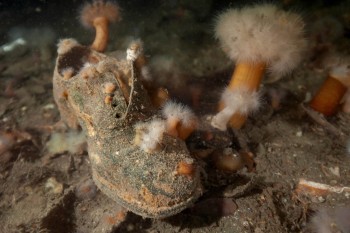
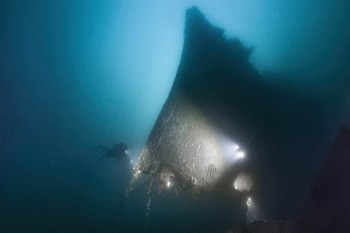
Emily Turton is the Project Lead on the Scapa 100 initiative, a group of likeminded collaborators from across the world, who wished to document Orkney’s maritime history. After a successful application to the Ministry of Defence, the team were the first group of civilian divers to see the wrecks of the HMS Hampshire and HMS Vanguard in the 21st century, but this night’s talk was wholly centred on the Oak, whose wooden fittings are showing real deterioration after their 87 years underwater. The superstructure however was showing remarkable resilience, hardly surprising in a heavily armoured warship.
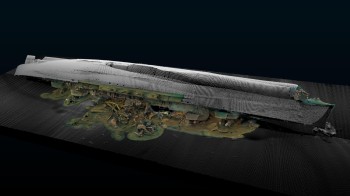
As well as still images of the wreck as she lies propped up on one side, though upside down, there was a rare treat in seeing animated photogrammetry; a technique of taking thousands of still images and stitching them together to create a three-dimensional image. The blast holes from the torpedoes were shown with an accompanying diver for perspective, showing just how catastrophic the final blast had been. The first two strikes were survivable, the third and fourth were not.
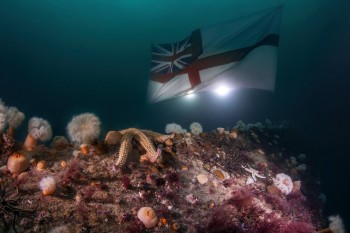
Ross Balfour, Commander of the Royal Navy divers from Charlie Squadron commended Emily on her professionalism in the depiction of the wreck as she lies today, and there was some laughter in the room when he admitted that they had been unable to keep up with her and her team underwater. Charlie Squadron, of course, had been in Orkney to recover and replace the Ensign on the ship, as they do every year. Questions were encouraged from the floor, and covered a gamut of topics, from family history to the ecology of the wreck.
As so much interest was shown in the talk, it is likely to be run again. Keep an eye on the Stromness Museum social media for updates.
This talk was a Buchan Lecture, kindly sponsored by the Society of Antiquaries of Scotland and:
- University of Dundee
- Newcastle University
- Huskyan Charters
- Servitech International Ltd
- R Lourie
- J Mitchell
Thanks also go to the European Marine Energy Centre (EMEC) and the Islands Centre for Net Zero (ICNZ).